

Key Takeaways
- Cravings are learned associations — your brain links coffee, stress, or driving with cigarettes (Carter & Tiffany, Addiction, 1999).
- Hypnotherapy works by changing those associations in a relaxed, focused state — not by forcing willpower.
- The urge to smoke typically rises, peaks within minutes, and passes. You just need a way through those minutes.
- Most cravings become manageable within 1-2 weeks of quitting. The first few days are the hardest.
If you’ve tried to quit before, you know the pattern: a craving hits and suddenly you’re lighting up before you’ve even decided to. It feels automatic. It’s not weakness — it’s your brain running a learned programme.
At Make Changes NLP & Hypnotherapy, Wendy Gadsby doesn’t ask you to white-knuckle through cravings. Hypnotherapy changes the programme.
How It Works
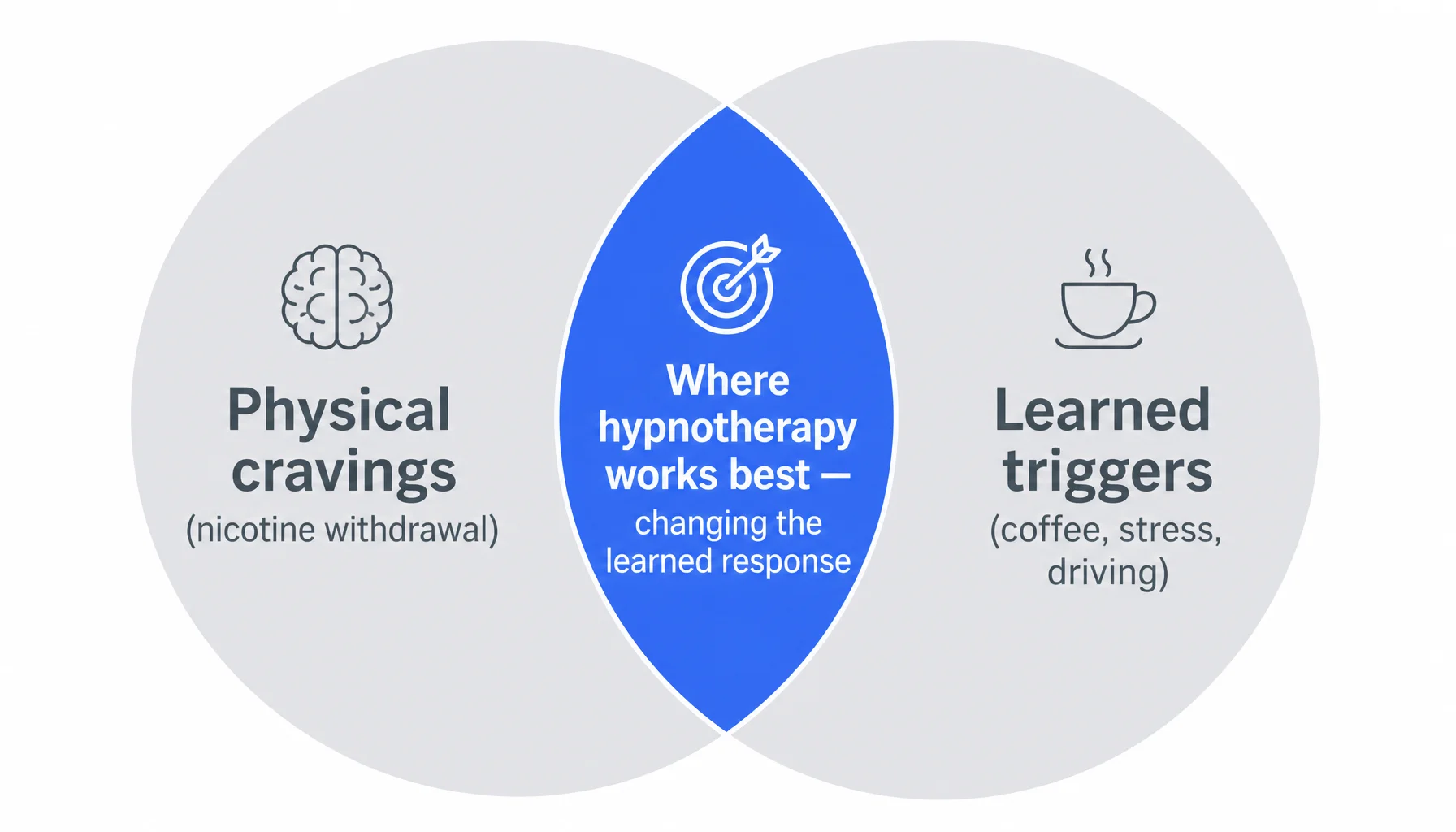
Nicotine cravings aren’t just physical withdrawal. They’re conditioned responses. Your brain has linked certain situations — coffee, stress, driving, after meals, around other smokers — with lighting up. Research on cue reactivity confirms that smoking-related cues trigger craving automatically (Carter & Tiffany, Addiction, 1999).
Hypnotherapy works by accessing those associations in a relaxed, focused state. You’re guided into deep calm — similar to being absorbed in a film — where your mind becomes more open to new programming. Instead of “stress = cigarette,” you rehearse “stress = three deep breaths.” Instead of “finished meal = smoke,” you practise “finished meal = glass of water.”
You stay in control throughout. You’re not being told what to do. You’re practising a different response, so when the real situation hits, your brain has already run the new script.
What to Expect
A craving typically rises, peaks within 2-5 minutes, and passes. Most people fail not because they’re weak but because they don’t have a strategy for those few minutes.
The session teaches you that strategy. You practise:
- Noticing the urge without obeying it
- Breathing through the peak
- Redirecting your attention (water, walk, a grounding phrase)
- Letting it pass
Between sessions, you reinforce this with practice. The first 3-5 days are usually the hardest — that’s when the nicotine is leaving your system and old triggers are still active. By week two, most people find cravings are noticeably weaker.
Some need one session. Others benefit from a follow-up to strengthen the new response against specific triggers (social smoking, work stress, alcohol). Wendy discusses what’s realistic in your consultation.
Frequently Asked Questions
How long do cravings last after hypnotherapy?
The physical craving for nicotine fades within 3-5 days. The learned cravings (after meals, with coffee) take longer — usually 1-2 weeks. The session gives you tools for both.
Will I still get cravings?
Probably, but they’ll feel less urgent and more manageable. The goal isn’t zero cravings — it’s being able to notice one and let it pass without acting on it.
What if earlier quit attempts have not changed my cravings?
Our focus is the learned cue and the response: what the craving means to you, how you direct attention and what you practise doing next. Bring your previous experiences to the conversation so the work addresses the patterns that remain.
Is one session enough for cravings?
For many, yes. If your triggers are straightforward (coffee, after meals), one session plus practice works well. Complex triggers (social smoking, emotional smoking) may benefit from a follow-up.
About the Author
Wendy Gadsby founded Make Changes NLP & Hypnotherapy in Melbourne. Certified Hypnotherapist, NLP Practitioner, and NLP Master Practitioner with over 15 years of experience and 5,000+ clients supported. Her approach is practical, direct, and grounded in real behaviour change.
Book a free consultation → | Learn more about Wendy →
Medical Disclaimer
This article is for general education only. It is not medical advice. Hypnotherapy may support smoking cessation but does not guarantee results. If you have health concerns, speak with a qualified health professional.