

Key Takeaways
- Specific phobia affects an estimated 7.4% of people across the lifespan (Wardenaar et al., Psychological Medicine, 2017).
- Hypnotherapy works with the learned fear response — your body reacts before logic catches up.
- A meta-analysis of 15 studies found hypnosis produced beneficial effects for anxiety vs. control conditions (Valentine et al., 2019).
- Gradual, supported practice (not forced confrontation) is what builds lasting change.
You already know your fear doesn’t make logical sense. That’s not the problem. The problem is your body reacts anyway — racing heart, tight chest, urgent need to escape — before you have time to think.
Whether it’s flying, dogs, needles, heights, lifts, spiders, or public speaking, a phobia can shrink your world. You avoid things. You plan around it. You say no to opportunities, travel, appointments, family events, because you don’t want to feel that fear again.
At Make Changes NLP & Hypnotherapy, Wendy Gadsby takes a practical approach. No forcing. No “just face it.” Just careful, tailored work that helps your mind learn a different response — from the inside out.
How It Works
A phobia is a learned fear response. At some point, your brain linked a situation with danger. Once that link forms, your nervous system treats it as real — even when you know it’s not. That’s why telling someone “turbulence is normal” or “spiders are harmless” rarely fixes anything. Reassurance hits the logical brain. The fear lives in the automatic one.
Hypnotherapy works with that automatic layer. You’re guided into a calm, focused state — like being absorbed in a film — where your mind becomes more open to updating old associations. You’re not asleep. You’re not out of control. You can speak, move, and stop anytime.
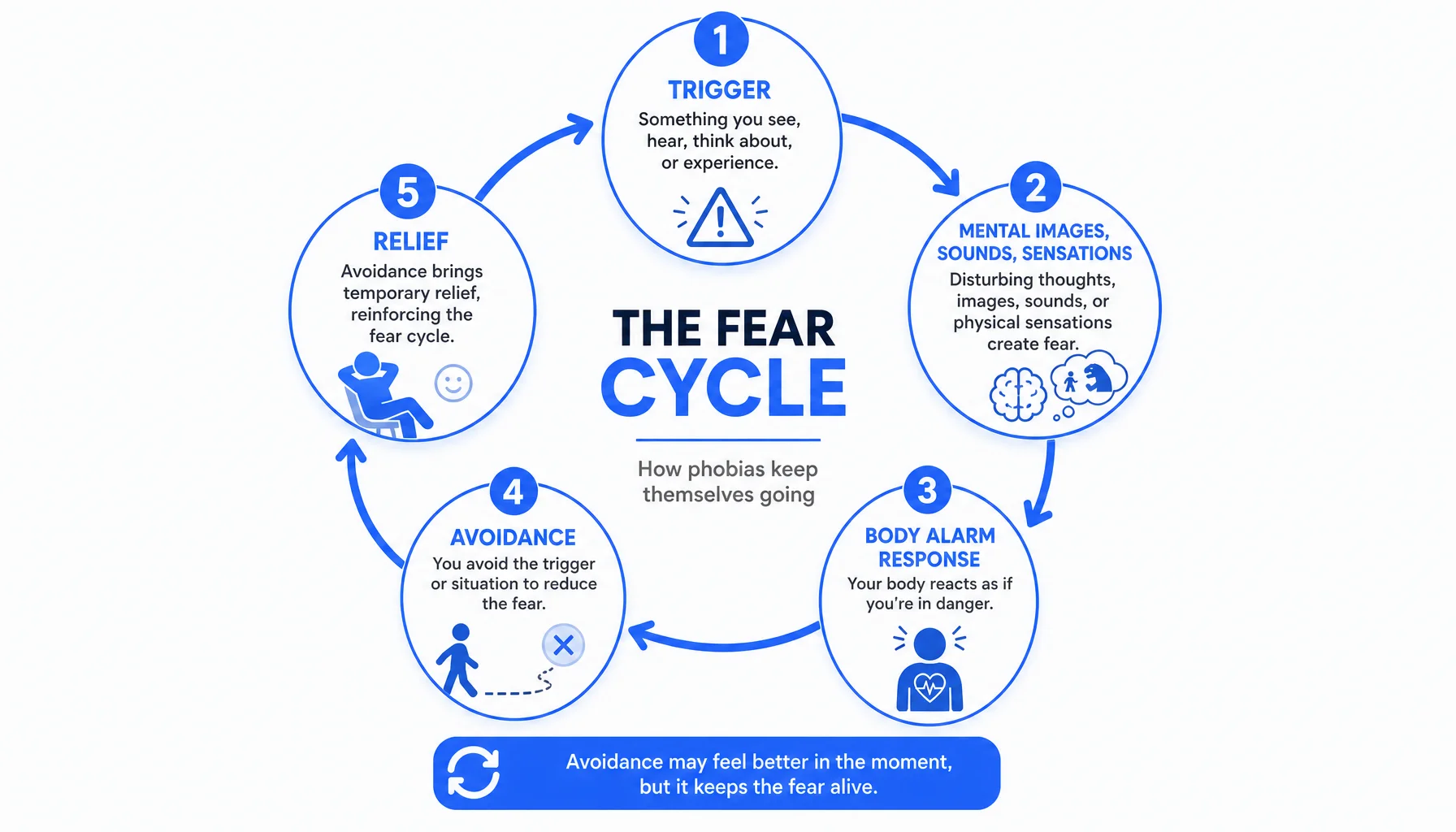
The fear cycle looks like this: trigger → mental images/sounds/sensations → body alarm response → avoidance → relief. That relief tells your brain “avoiding worked,” which strengthens the fear. Hypnotherapy interrupts this by creating a different experience: trigger → calm body → new mental image → choice.
NLP adds practical tools. Someone with a spider phobia might picture the spider as huge, close, and threatening. NLP helps change that internal image — smaller, further away, less intense. Same trigger, different internal response.
You already have the resources you need. You’re confident at work. Calm with friends. You handle responsibilities well. The fear is just one context where the volume got turned up too high. Hypnotherapy helps you transfer existing strengths into the place they’re needed.
What the Research Says
The phobia-specific research base is smaller than for some therapies like exposure-based CBT. But the anxiety research is strong. Valentine et al. (2019) found hypnosis outperformed control conditions for anxiety reduction across 15 trials. Hammond (2010, International Journal of Clinical and Experimental Hypnosis) concluded hypnosis supports anxiety reduction across settings — while honestly noting study quality varies.
For fear of flying specifically, an estimated 10-40% of adults experience some degree of it (Oakes & Bor, Travel Medicine and Infectious Disease, 2010). Hypnotherapy can help by changing the mental rehearsal. Instead of imagining worst-case scenarios for weeks before a flight, you practise seeing yourself walk through the airport calm, responding to turbulence as normal movement, arriving safely.
Exposure-based approaches are well-supported (Craske et al., Behaviour Research and Therapy, 2014). Hypnotherapy can complement them — preparing you internally before external practice. The evidence doesn’t say hypnosis replaces exposure. It says hypnosis can make the steps feel more achievable.
NLP research is more limited. A review of 10 studies (Sturt et al., British Journal of General Practice, 2012) found limited evidence and variable quality. At Make Changes, NLP is used as a practical toolset alongside hypnotherapy — not as a standalone guarantee.
What to Expect
Your first session starts with understanding your fear, not a textbook version of it. Fear of flying means something different to everyone — turbulence, being trapped, panic symptoms, loss of control. Fear of dogs might be barking, being jumped on, or an unexpected appearance. The more specific the pattern, the more useful the session.
During hypnosis, you sit comfortably. Eyes closed. Wendy guides you through relaxation. You mentally rehearse handling your specific trigger — boarding a plane, walking past a dog, sitting in a dental chair, driving over a bridge. You stay in control the entire time.
After the session, you practise. Small steps. A calming cue you can use anywhere. A changed mental image of the trigger. Progress often shows up subtly first — thinking about a flight without your stomach dropping, looking at a photo without panic, walking on the same side of the street as a dog.
Unlike exposure-only approaches that start with real-world practice, hypnotherapy lets you build internal calm first. It also goes deeper than coaching or self-help by working directly with the automatic fear response. Clinical hypnotherapy is not stage hypnosis — you won’t be made to perform, reveal anything private, or act against your values. It’s calm, private, and focused on your goals.
Frequently Asked Questions
Can hypnotherapy help my phobia?
It can — especially by changing the automatic fear response. Results vary. How long you’ve had the fear, its intensity, and whether trauma is involved all matter.
How many sessions might I need?
Varies. Some people notice change quickly. Longer-standing or complex phobias may need more sessions. Progress also depends on what you practise between appointments.
Is hypnotherapy suitable for fear of flying?
Yes — mental rehearsal of the entire journey (airport, boarding, take-off, turbulence, landing) is exactly what hypnotherapy does well. Book early enough to practise before your flight.
What if it’s linked to trauma?
Seek a practitioner who works gently and doesn’t force you to relive events. Professional mental health support should be in place for trauma, severe panic, or safety concerns.
About the Author
Wendy Gadsby founded Make Changes NLP & Hypnotherapy in Melbourne. Certified Hypnotherapist, NLP Practitioner, and NLP Master Practitioner with over 15 years of experience and 5,000+ clients supported. Her approach is practical, direct, and grounded in real behaviour change.
Medical Disclaimer
This article is for general education only. It does not diagnose or treat any condition. Hypnotherapy may support fear and phobia management but is not a substitute for advice from a qualified health professional. If your fear is linked with trauma, severe panic, self-harm thoughts, or safety concerns, seek appropriate professional support. Book a free consultation to discuss your situation.