

Key Takeaways
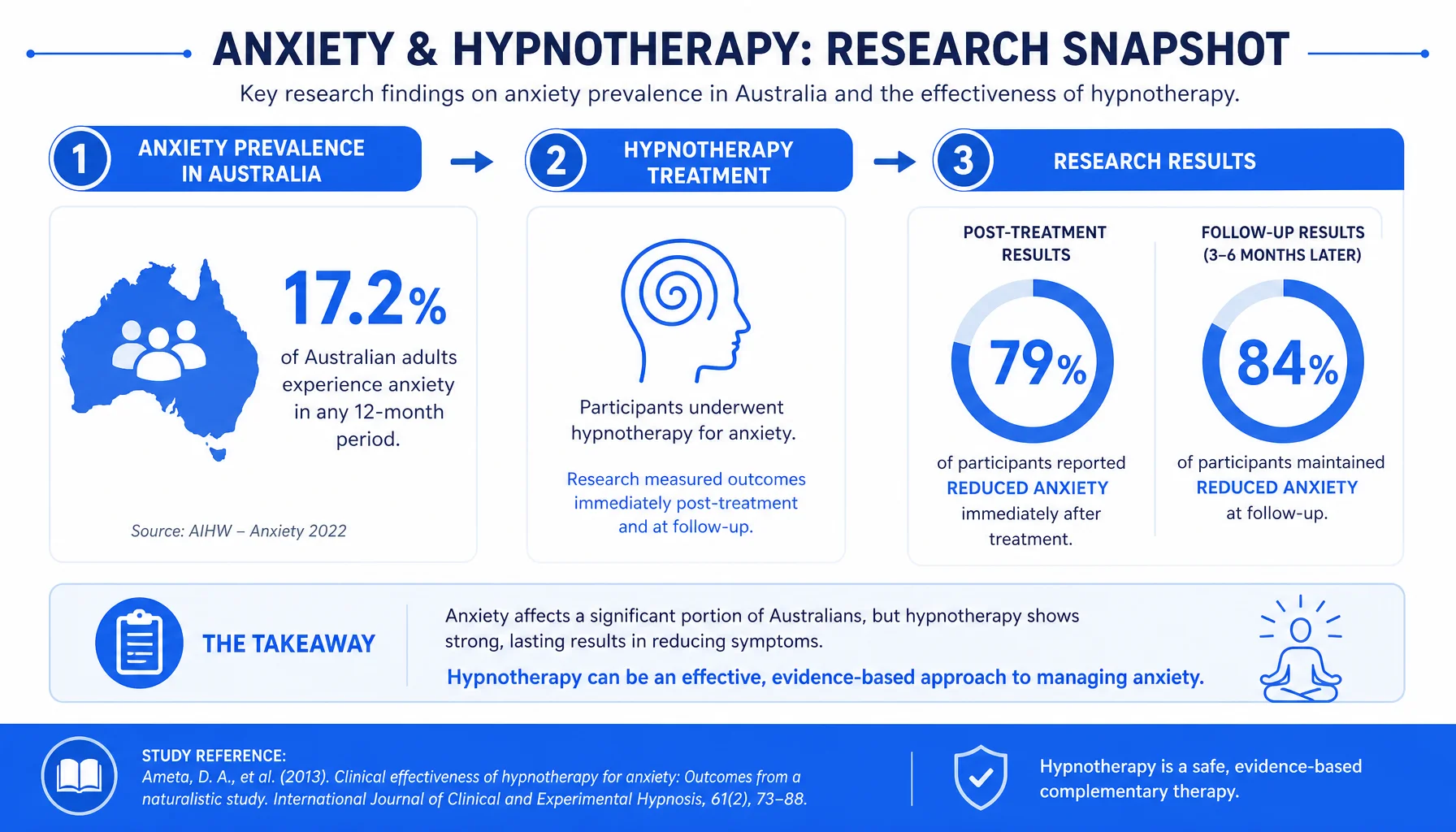
- 17.2% of Australians experienced an anxiety disorder in the previous 12 months (ABS National Study of Mental Health and Wellbeing, 2023).
- A meta-analysis of 15 trials found hypnosis reduced anxiety more than 79% of control conditions at post-treatment and 84% at follow-up (Valentine et al., International Journal of Clinical and Experimental Hypnosis, 2019).
- Hypnotherapy works with the body’s stress response — not just your thoughts — helping you practise calm as a physical skill.
- It’s not a crisis service. For severe or trauma-related symptoms, seek support from a qualified health professional.
You might be functioning fine on the outside. But inside — tight chest, racing thoughts, avoiding things you used to do, waking at 3am with your mind already running. Anxiety doesn’t always look like panic. Sometimes it looks like holding it together while feeling exhausted.
At Make Changes NLP & Hypnotherapy, Wendy Gadsby works with people who’ve already tried pushing through, breathing apps, positive thinking. Those things help. But when the pattern keeps returning, it’s worth looking at what’s driving it underneath.
How It Works
Anxiety isn’t just “thinking too much.” It involves your muscles, breathing, digestion, sleep, and attention. When your brain perceives threat — real or not — your body prepares to protect you. That’s useful in short bursts. The problem is when the switch stays on.
Hypnotherapy helps by guiding you into a calm, focused state where your body can actually settle. From that steadier place, you practise new responses. Not by fighting the anxiety — fighting makes it louder — but by learning to notice it, breathe, and let it pass.
What hypnosis is not: sleep, mind control, or stage entertainment. You’re aware the whole time. You can speak, move, stop at any point. It’s more like being absorbed in a film — relaxed but focused.
The subconscious angle matters. Anxiety often runs on old associations. You once had a panic attack on a train. Now your body tenses at the thought of public transport. You know logically it’s safe. Your nervous system didn’t get the memo. Hypnotherapy helps update those automatic patterns — gently, without forcing you to relive anything.
NLP (Neuro-Linguistic Programming) adds practical tools. It helps you change how worry appears in your mind — turning down the volume on an inner critic, shrinking a catastrophic mental image, building a physical anchor for calm you can use anywhere.
What the Research Says
The Valentine meta-analysis (2019) is the standout: 15 randomised controlled trials, hypnosis outperformed control conditions for anxiety reduction at both post-treatment (79%) and follow-up (84%). That’s not a guarantee — no ethical practitioner claims that — but it’s a solid evidence base.
Brain imaging research links hypnosis with changes in attention, body awareness, and control networks (Jiang et al., Cerebral Cortex, 2017). Hypnosis isn’t just relaxation. It’s a distinct mental state that can support new learning.
A broader review by Elkins et al. (2015, International Journal of Clinical and Experimental Hypnosis) found evidence for hypnosis across anxiety, pain, and procedure-related distress — while also noting the need for better-designed studies. The honest take: hypnosis has promise, especially as part of a broader plan.
For trauma-related stress: Hypnotherapy can support grounding and emotional regulation, but trauma work requires pacing and safety. NICE guidelines (NG116, 2018) recommend trauma-focused psychological therapies as first-line. Hypnotherapy may complement that care — it doesn’t replace it.
What to Expect
Your first session starts with a real conversation. What triggers the anxiety? When did it start? What have you tried? “I don’t want anxiety” is too broad. A better goal: “I want to drive to work without my chest tightening” or “I want to speak in meetings without freezing.”
During hypnosis, you sit comfortably. Eyes closed. Wendy guides you into relaxation. The suggestions are specific to your situation — whether that’s arriving at work grounded, sleeping without replaying the day, or feeling safe in social settings.
Between sessions, you practise. Small things: a breathing cue, a grounding exercise, noticing when you’re bracing and choosing to soften. Progress might look like recovering faster after stress, avoiding fewer things, sleeping slightly better. These steps matter.
Unlike approaches that focus only on talking or only on thinking patterns, hypnotherapy lets you rehearse change — feeling calm in your body, not just understanding it in your head. It sits alongside other support (counselling, CBT, lifestyle changes) rather than replacing it. If symptoms are severe or you have safety concerns, speak with a health professional first.
Frequently Asked Questions
Can hypnotherapy help anxiety?
For many people, yes. The research supports it. But it’s not magic — your results depend on readiness, consistency, and the fit with your practitioner.
What about trauma or PTSD?
Hypnotherapy can support grounding and regulation. It should never force you to relive events. For trauma, seek a practitioner who works gently and prioritises safety. Professional mental health support should be in place where needed.
How is NLP different from hypnotherapy?
NLP is more conversational — it changes how you internally represent anxiety triggers. Hypnosis reinforces those changes in a relaxed state. They work well together.
Before booking, ask yourself:
What situations trigger me most? What do I avoid? What would I like to feel instead? Then book a conversation — not a commitment.
About the Author
Wendy Gadsby founded Make Changes NLP & Hypnotherapy in Melbourne. She’s a Certified Hypnotherapist, NLP Practitioner, and NLP Master Practitioner with over 15 years of experience and 5,000+ clients supported. Her approach is practical, direct, and focused on real change — not buzzwords.
Medical Disclaimer
This article is for general education only. It does not diagnose or treat any condition. Hypnotherapy may support anxiety and stress management but is not a substitute for advice from a qualified health professional. If symptoms are severe, persistent, or affecting your safety, seek appropriate support. Do not change or stop existing treatment without consulting your health professional. Book a free consultation to discuss whether Make Changes is right for you.